



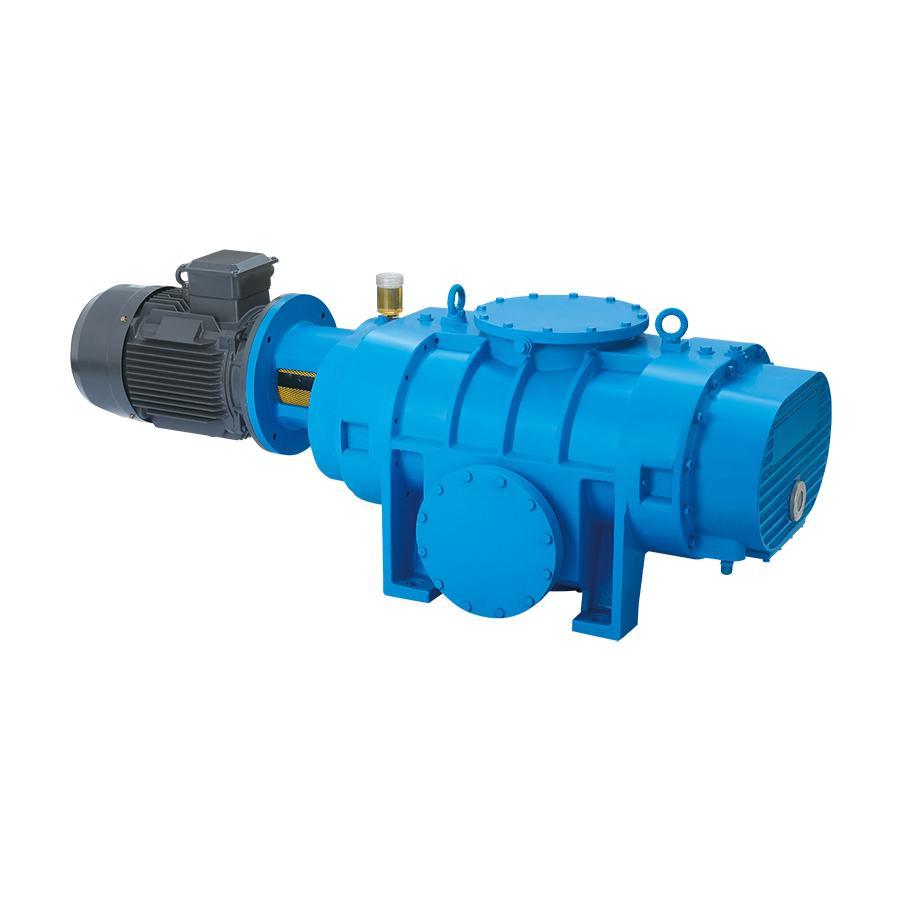
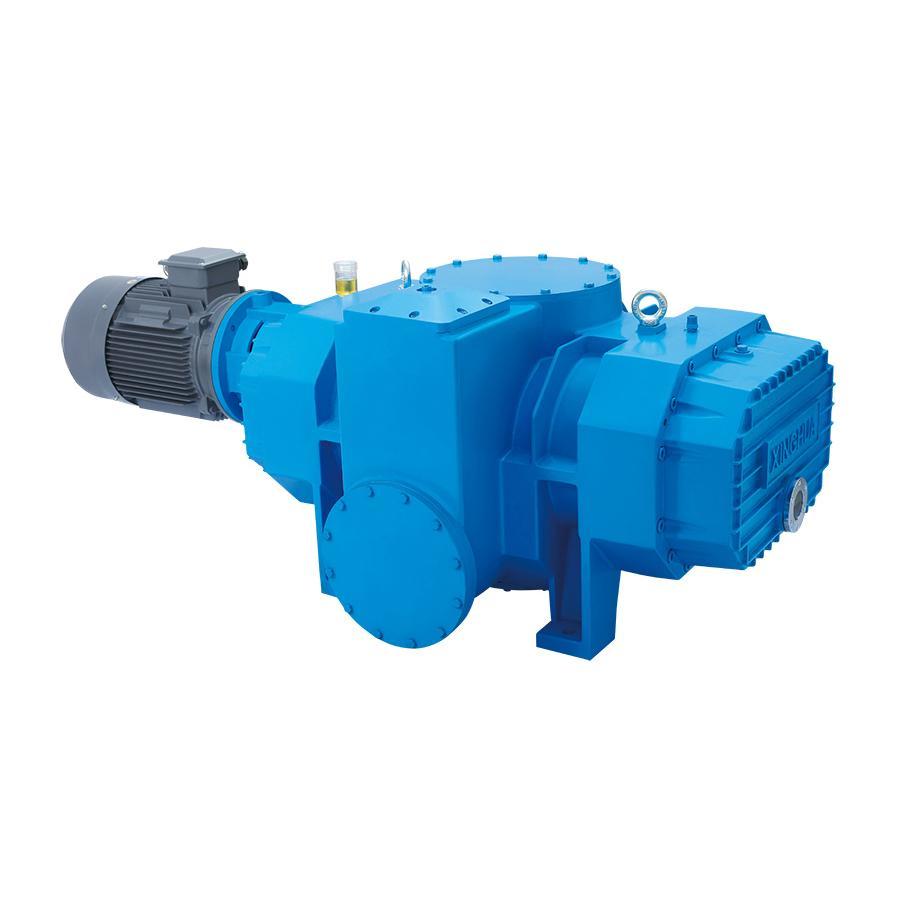
ZJP Roots vacuum pump (low noise) series
Telephone


Detailed Introduction
Roots vacuum pumps mainly consist of a pair of synchronously rotating "8"-shaped rotors and two semicircular pump chambers. This type of pump cannot exhaust independently and must be used in series with a forepump (such as a sliding valve pump, vane pump, water ring pump, oil ring pump, etc.). Connecting a Roots vacuum pump in series in front of the forepump's intake port forms a unit that improves the vacuum degree of the forepump and significantly increases the pumping speed within the effective working range. The ultimate pressure of the Roots vacuum pump is determined by the forepump; the data in the table represents the lowest ultimate pressure with standard configuration (using a double-stage oil-sealed mechanical vacuum pump). Roots pumps are widely used in vacuum casting, vacuum melting, vacuum degassing, vacuum coating industries, and vacuum distillation, vacuum drying, etc., in the chemical and pharmaceutical industries. The pump is insensitive to small amounts of dust. Our company's Roots vacuum pumps have been continuously improved for over 20 years and have the following advantages:
• The rotors are processed using high-precision, dedicated CNC machine tools and are dynamically balanced, ensuring good geometric symmetry and uniform rotor meshing clearance. The pump body and side cover are processed using a machining center for high precision. Therefore, our company's Roots vacuum pumps operate smoothly with low noise, low vibration, and low ultimate pressure (high vacuum).
• The pump's transmission components use a reliable clearance elimination structure, allowing the pump to operate for extended periods under high pressure differences.
• Quick start-up, capable of reaching ultimate vacuum in a short time.
• There are no mutually sliding parts inside the pump chamber, eliminating the need for oil lubrication and preventing oil vapor from contaminating the system.
• Safe and reliable; the ZJP series itself is equipped with an overflow valve for automatic protection.
• Compact structure, small footprint; three exhaust ports (left, right, and bottom) are available for selection, facilitating user installation.

Diagram of ZJ/ZJP pump operating principle
Curve Chart

Performance curve of ZJ/ZJP type Roots vacuum pump air extraction rate and inlet pressure
Technical Parameters
| Model | Ultimate Pressure Pa | Pumping Speed | Maximum Allowable Pressure Difference | Inlet and Outlet Diameter (mm) | Matching Power | Maximum Compression Ratio at Zero Flow | Weight | ||
| Equipped with Double-Stage Oil Seal Mechanical Vacuum Pump |
Equipped with Single-Stage Oil Seal Mechanical Vacuum Pump |
L/S | HPa | Inlet | Outlet | Kw | Kg | ||
| ZJP-70 | ≤2×10 -2 | ≤1×10 -1 | 70 | 100 | 80 | 50 | 1.5 | ≥35 | 100 |
| ZJP-150 | 150 | 80 | 100 | 100 | 2.2/3 | ≥40 | 220 | ||
| ZJP-300 | 300 | 80 | 150 | 150 | 4 | ≥40 | 300 | ||
| ZJP-600 | 600 | 50 | 200 | 200 | 5.5/7.5 | ≥45 | 575 | ||
| ZJP-1200 | 1200 | 50 | 250 | 200 | 11/15 | ≥50 | 860 | ||
| ZJP-2500 | 2500 | 30 | 320 | 250 | 18.5/22 | ≥50 | 1480 | ||
Note: The ultimate pressure in the table is measured using a McLeod gauge.
Note: ZJP series refers to the structure with overflow valve.
Note: The performance parameters of ZJC and ZJPC magnetically driven Roots vacuum pumps are the same as those of ZJ and ZJP pumps.
Keywords:
LG/LGB series dry screw vacuum pumps
Roots Vacuum Pump Series
H, 2H slide valve vacuum pump series
Liquid ring vacuum pump series
Oil-free reciprocating vacuum pump series
KT series high vacuum oil diffusion pump series
Z-series oil diffusion jet pump (oil booster pump)
Vacuum unit series
Related Products


No.1158, Sanjia Qihang Road, Jiaojiang New District,Taizhou City,Zhejiang Province